
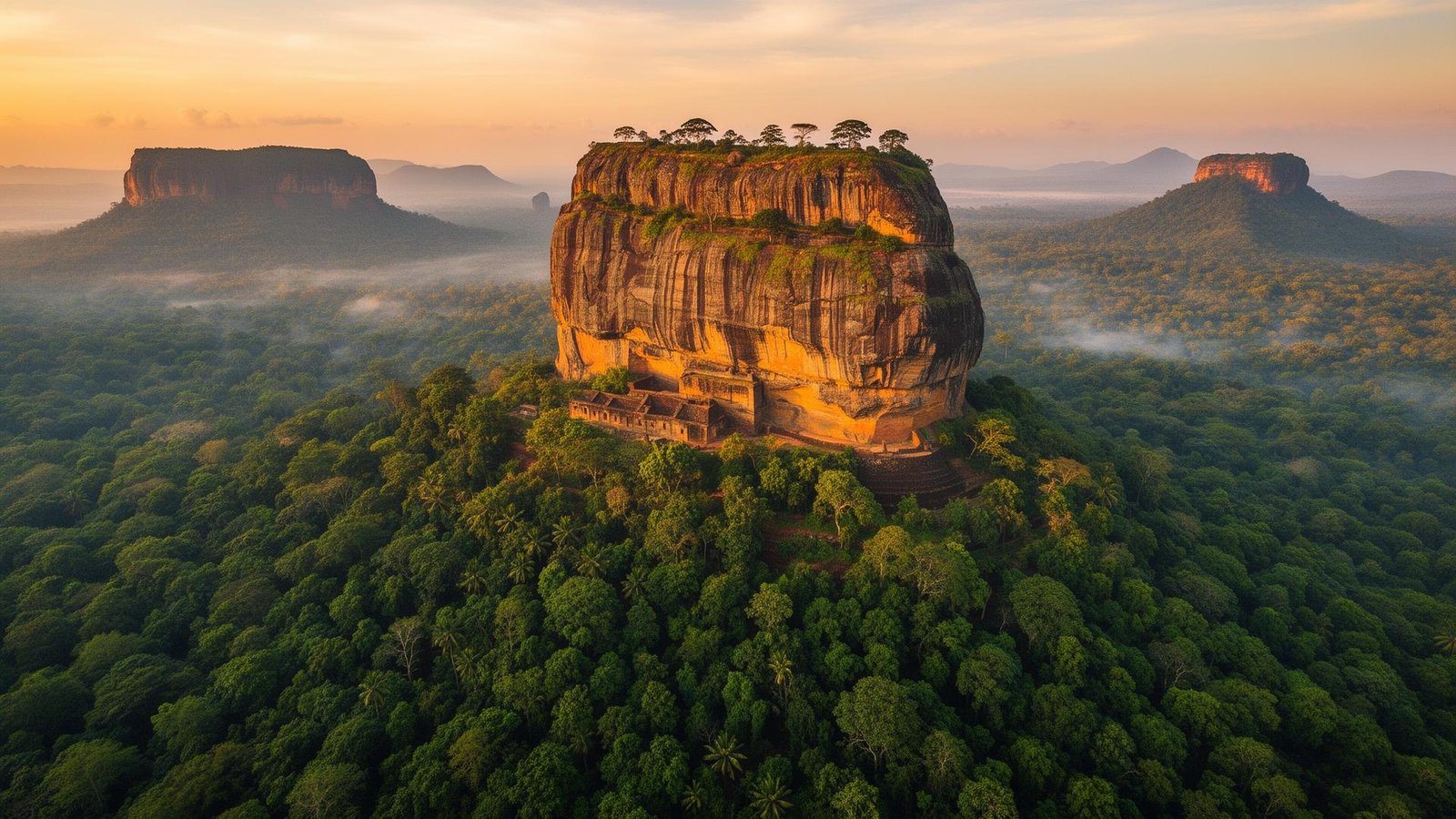
Destination Overview
An island chapter, slowly read.
Polonnaruwa is the second of Sri Lanka's great royal cities and, for many travellers, the more rewarding of the two. Where Anuradhapura is vast, scattered and meditative, Polonnaruwa is concentrated, walkable, and almost theatrical in its preservation. Within a single morning's slow exploration you can stand before a 12th-century royal audience hall, walk through the cloistered chambers of a king's palace, climb to a circular relic house carved with stone lions, and end at Gal Vihara — four colossal Buddhas hewn directly from a single granite face, including a fourteen-metre reclining figure that is, in the gentle restraint of its expression, one of the great masterpieces of Asian sculpture.
The city was the capital of Sri Lanka for two centuries between 1070 and 1232 CE, and it was built with the deliberate confidence of a kingdom at its peak. The greatest of its kings, Parakramabahu I, ruled for thirty-three years in the 12th century and left behind a city of paved streets, hospitals, libraries and temples; an irrigation system of such ambition (the Parakrama Samudra, the 'Sea of Parakrama', a 2,400-hectare reservoir) that it is still in active use; and a body of religious sculpture and architecture that ranks among the finest of South Asia's classical age.
What makes Polonnaruwa exceptional, beyond its scale, is the quality of its preservation. The city was abandoned in the 13th century after South Indian invasions and the slow shift of political power back to the wet zone, and the jungle reclaimed it for seven hundred years. When archaeologists began serious work in the 19th and 20th centuries, they found palace walls still standing to two and three storeys, frescoed chambers, intact carved guard-stones, and the unbroken serenity of Gal Vihara, where the original 12th-century chisel marks are still visible on the granite. To cycle through the ruins at golden hour, with troops of toque macaques chattering in the canopy and the long evening light raking across the brick, is one of the great pleasures of any cultural-triangle journey.
Lankurious approaches Polonnaruwa at the right pace and from the right base. We bed you at Ulagalla or at Wild Coast Tented Lodge on a dedicated cultural-triangle leg, and arrange a private historian, a sunrise cycle through the inner ruins, a candlelit picnic lunch under the trees within the archaeological park, and an afternoon at Gal Vihara when the carving is at its most photogenic. The site is large enough to absorb a full day and rewards every minute of it.
Why Visit
Three reasons to come to Polonnaruwa.
Gal Vihara is one of the supreme masterpieces of Sri Lankan art — four monumental Buddhas carved from a single granite cliff, almost perfectly preserved after nine centuries.
Polonnaruwa is the most concentrated and walkable of the island's ancient capitals, and the easiest to grasp in a single visit.
The site is fringed by the Parakrama Samudra, a 12th-century reservoir of staggering scale that draws elephants, herons, painted storks and crocodiles to its shoreline — a rare combination of ruin and wildlife within a single morning.
History & Heritage
The long story behind the place.
Polonnaruwa became the capital of Sri Lanka in 1070 CE, when King Vijayabahu I reclaimed the island from a Chola occupation and chose this drier, more easily defended location over the old seat at Anuradhapura. For the next 162 years, Polonnaruwa flourished under a succession of remarkable rulers, the greatest of whom — Parakramabahu I (1153–1186) — unified the island under a single throne for the first time in its history.
Parakramabahu's reign is the high-water mark of the medieval Sinhalese state. He built the great reservoir that still bears his name, expanded the city's hospital and library systems, restored hundreds of village temples and monasteries, and oversaw the carving of Gal Vihara as the spiritual centrepiece of the capital. His Royal Palace, the seven-storey 'Vejayanta Pasada', was the most ambitious wooden building of its age in Asia; even its surviving brick foundations and surviving lower walls give a sense of a structure that contemporary chronicles compared to the celestial palaces of the gods.
The kingdom declined rapidly after Parakramabahu's death. Successive South Indian invasions in the 13th century, combined with the collapse of the irrigation system, drove the capital first to Dambadeniya and then progressively westward into the wet zone, and Polonnaruwa was abandoned to the forest. Excavation and restoration began under the British in the late 19th century and has continued, with great care, ever since. The site was inscribed by UNESCO in 1982.
Top Experiences
What to do, slowly.
Sunrise cycle through the ruins
Private bicycles delivered to the gate, a resident historian as your guide, and the entire inner city to yourselves before the first coach arrives. Tea and breakfast served at a quiet corner of the Royal Palace gardens.
Gal Vihara at golden hour
An arranged late-afternoon visit to the four carved Buddhas, when the granite catches the last warm light and the standing figure throws a thirty-metre shadow across the platform.
Picnic lunch in the archaeological park
A linen-laid table beneath the trees within the park, brought from Ulagalla's kitchen — Ceylon prawns, hoppers, mango salad, and a long, unhurried hour in the shade.
Elephants on the reservoir shoreline
A late-afternoon drive along the bund of the Parakrama Samudra, with binoculars and a naturalist, in search of the resident elephant herd that drinks at the southern end at dusk.
Village cycle to Medirigiriya
An hour's ride through paddy fields and tank villages to the circular vatadage at Medirigiriya — a less-visited 9th-century shrine that is, in the perfection of its proportions, almost as moving as Gal Vihara.
Best Time To Visit
The calendar, in three movements.
May – September
The cultural-triangle dry season. Hot at midday but reliably rain-free, with crisp dawns and the best light for the carvings. The classical safari-and-ruins window.
December – March
Slightly cooler and dry — the classic luxury circuit window, comfortable through the day and ideal for cycling. Often paired with Sigiriya and Kandy.
October – November
The second inter-monsoon brings short, dramatic afternoon storms and saturates the surrounding paddy in a brilliant green. Photography is at its finest; bring a light shell.
Luxury Accommodation
Where to stay.
Ulagalla, Anuradhapura
Heritage manor · 90 minutes from the site
Restored 19th-century chieftain's manor on 58 acres of paddy and forest, with private pool chalets and the finest country table in the region. The benchmark base for Polonnaruwa.
Water Garden Sigiriya
Contemporary luxury · 60 minutes from the site
Stand-alone pool villas around a private network of lily ponds, with the rock of Sigiriya as a backdrop. Often paired with Polonnaruwa as a single cultural-triangle base.
Wild Coast Tented Lodge
Resplendent Ceylon · Safari tents (Yala extension)
For travellers continuing south to Yala, the most theatrical safari camp on the island — bamboo-domed tented suites on the edge of the park, with elephants drifting past at dusk.
Suggested Tours
Journeys that pass through Polonnaruwa.
Travel Tips
Quiet wisdom from the road.
- ·
Cover shoulders and knees throughout the site — this is enforced at Gal Vihara and the Tooth Relic shrine.
- ·
Cycle or drive between the major clusters; walking the full circuit in the heat is genuinely punishing.
- ·
Carry water, a hat and a soft pair of socks for the temple platforms where shoes must be removed.
- ·
Photograph Buddhas from the front or the side — turning your back on a Buddha image for a selfie is considered deeply offensive and may incur a fine.
- ·
The site is open from 7am; arrive at the gate at opening to have the inner ruins to yourselves for the first hour.
Gallery
A few frames.

Shall we begin?